
This new enabling platform of organic materials was the innovation brought by Margaret Kocherga, founder of Margik and a Chain Reaction Innovations’ (CRI) Cohort 4 innovator.
In 2019, Kocherga, who holds a Ph.D. in nanoscale science from the University of North Carolina at Charlotte, created the company, then called Light and Charge Solutions, LLC as a result of Ph.D. research she was doing in the field of organic electronics, which fascinated her.
“I thought it was so cool,” Kocherga said. “I can make materials, and they can make light.”
Kocherga joined CRI’s Cohort 4 at the U.S. Department of Energy’s (DOE) Argonne National Laboratory in July 2020. CRI is a two-year entrepreneurship program, which embeds innovators in the Lab to help them grow their early-stage technologies. While embedded, Kocherga is working with Argonne scientist Jie Xu as her primary investigator (PI) at the Lab’s Center for Nanoscale Materials.
About Margik
Unlike the materials used in traditional electronics, the powders that Margik makes for use in organic electronics contain organic elements (e.g. carbon, hydrogen, nitrogen, and silicon), which are found in living organisms and nature.
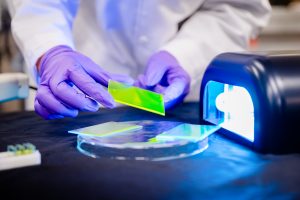
Margik was initially named Light and Charge Solutions, but its branding name was changed in 2021 to Margik, a name meaning “loving change,” which correlates with the company’s desire ‘to change the mindset of manufacturing to sustainable devices,’ Kocherga said.
Impact
“Our ultimate goal is to reduce consumer electronic impact on the environment, while enabling advanced devices with the materials we’re making,” she said.
Electronic waste from traditional electronics often includes toxic elements that are rarely recycled, taking up space in landfills because of the safety issues involved with recycling them. Organic electronics, however, have the potential to reduce such negative impact and to even become degradable. Margik’s aspiration is to be at the forefront of this change.
Organic electronics provide several benefits compared to traditional electronics, so it is advantageous for electronics manufacturers to switch to organic electronics.
By 2040, unless the electronics industry switches to sustainable organic electronics, the thin supply of natural resources that are used to manufacture traditional electronics will run out if consume them at the current rate.
Organic electronics allow for “very thin, very light technologies,” and by 2024 there could be a TV on the market “as thin as paper,” Kocherga said.
Unlike traditional electronics that usually cannot be recycled, organic electronics have the potential to
decompose, which would simplify their recycling.
In addition, organic electronics use “a lot less power,” reducing electrical consumption to charge devices, which consequently produces less CO₂, and will enable devices to work for longer periods of time without charges.
Milestones
Kocherga reached several milestones with Margik since joining Cohort 4. Materials that it manufactures were piloted at three different companies – a lighting company, a printable device display company and a light-up street sign company – that provided feedback on the powders. Margik is continuing to expand its materials portfolio from the core hexacoordinate silicon technology to thiazolothiazoles, which they’ve recently added.
The company received a National Science Foundation Small Business Technology Transfer Program (STTR) Phase I grant of $256,000.
Margik was also selected to participate in two accelerator programs for startups – Ventureprise 2.0 and the Advanced Materials Competition (AdMaCom) in Berlin.
How it Works
Margik has two main technology platforms made of organic, nanosized molecules and various functionalities of hexacoordinate silicon pincer complexes and thiazolothiazole derivatives. These materials will be delivered to customers in the form of powders, and typically range in color from pastel lime green to bright orange.
Organic electronics allow for “very thin, very light technologies,” and by 2024 there could be a TV on the market “as thin as paper,” Kocherga said.
The hexacoordinate silicon complexes are primarily employed as electron transport materials, due in part to their high environmental stability and thermal stability above 150 degrees Celsius.
The thiazolothiazole derivatives are used primarily to hold transport materials due to their highly efficient fluorescent blue pigments, which are stable in water, non-toxic, and have even been used as voltage sensors inside cell membranes.
The materials can be used to create lighting display screens for devices such as cell phones, virtual reality headsets and watches; organic solar cells; light-up signage; light bulbs; fabric dyes; consumer electronics and medical fluorescent markers (molecules that glow in the body).
Margik’s materials allow for a simpler, three-layer electrical device with a layer for hole transport, layer for the emitter, and layer for electron transport. The electron transport and hole transport are “must have” components that enable light emission in lighting devices, and charge extraction after light absorption in solar cells.
Margik is currently pursuing opportunities with light-up packaging, bottles, boxes, and containers. This packaging will be able to light-up brand logos, or other shapes with a variety of sensors for convenient lighting at the perfect timing: touch abled, motion triggered, and thermal change triggered.
“My goal is to be able to take a cell phone out of my pocket and say that I make stuff for this,” Kocherga said.